Dogs are much worse at regulating hydration than people are, and much better at hiding that anything is wrong. They cannot sweat meaningfully, they cool almost entirely by panting, and panting is itself a significant route of water loss. By the time a dog looks like it needs water, it has needed water for a while.
The baseline: how much a dog drinks in a day
The standard veterinary figure is roughly 50ml of water per kilogram of body weight per day — about 1 fluid ounce per pound. For common sizes:
- 5kg / 11lb (small terrier): about 250ml a day
- 10kg / 22lb (French bulldog): about 500ml a day
- 20kg / 44lb (border collie): about 1 litre a day
- 30kg / 66lb (labrador): about 1.5 litres a day
- 40kg / 88lb (german shepherd): about 2 litres a day
That is a resting baseline in mild weather. Exercise and heat both push it up substantially.
The walk formula
For working out what to carry, this is close enough and easy to remember:
Mild weather (under about 20°C): 15ml per kg of dog, per hour of walking.
Warm weather (over about 25°C): 30ml per kg of dog, per hour.
So a 20kg dog on a one-hour summer walk wants roughly 600ml available. A 10kg dog on a 30-minute mild walk wants around 75ml — a couple of mouthfuls, which is why a full bottle is rarely necessary for short walks.
Two adjustments worth making: add roughly 50% for a flat-faced breed (pugs, bulldogs, boxers — they pant far less efficiently and overheat much faster), and add roughly 50% for a dog that is actually running rather than walking.
When to offer it
Little and often beats one large drink. A dog that gulps a lot of water at once after hard exercise is at risk of vomiting it straight back up, and in deep-chested breeds a large volume plus exertion is a bloat risk factor.
- Under 30 minutes, mild weather: generally not needed. Water at home before and after is fine.
- 30 to 60 minutes: offer once, roughly halfway.
- Over an hour: offer every 20 minutes or so.
- Hot weather or hard exercise: every 15 minutes, small amounts, and rest in shade while they drink.
Offer, do not force. A dog that turns water down twice in a row in mild weather is genuinely fine. A dog that refuses water while panting heavily in the heat is a warning sign, not reassurance.
The early signs of dehydration
Most owners know the late signs and miss the early ones. In rough order of appearance:
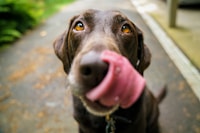
- Thick, ropey saliva. Usually the first thing you can actually observe.
- Panting that does not settle within a few minutes of stopping.
- Dry or tacky gums. Press a finger to the gum — the colour should return within about two seconds.
- Loss of skin elasticity. Gently lift the skin between the shoulder blades. It should drop straight back; a slow return means dehydration is already well established.
- Sunken-looking eyes and lethargy. Late signs. At this point the walk ends and you head for shade and a vet call.
The gum test is the one worth practising on a healthy dog, so you know what normal feels like on your dog before you ever need the comparison.
Carrying it without the hassle
The reason dogs go without water on walks is almost never that owners do not care. It is that the setup is annoying — a human bottle you have to cup your hand under, or a bowl at the bottom of a bag, and the walk is short so you skip it.
Two setups remove that friction:
- An integrated bottle with a fold-out bowl built into the cap. One hand, no assembly, nothing to hold. Unfold the 2-in-1 Portable Dog Water Bottle's bowl, pour, and your dog gets a proper drink — use the formula above to judge how much to offer, then fold it flat again once they're done.
- A bowl that fits the bottle you already carry. Best if you are bringing your own water anyway and would rather not switch bottles. The Foldable Dog Water Bowl screws onto a standard bottle neck and unfolds the same way.
Either way, the formula above still tells you how much to offer — the gear just decides how easy it is to actually do it.
Puddles, streams, and other people's bowls
Standing water is worth avoiding where you reasonably can. Puddles, ponds and communal bowls carry giardia, leptospirosis and blue-green algae — the last of which is genuinely lethal and blooms in warm, still water in summer. Rivers and fast-moving streams are lower risk but not zero.
Carrying your own water is not fussiness; it is the straightforward way to remove that category of risk entirely.
Water in cold weather
The most commonly skipped case. Dogs still lose water through panting in winter — cold air is very dry, and a dog working hard in the cold pants just as much. Because neither of you feels hot, the water stays at home. On winter walks over an hour, take it anyway.
The short version
- 15ml per kg per hour in mild weather, 30ml per kg per hour when it is warm.
- Small amounts often, not one big drink.
- Under 30 minutes in mild weather, you can skip it.
- Learn the gum test before you need it.
- Whatever you carry, it has to be easy — or it stays home.
This article is general guidance, not veterinary advice. If you are worried about your dog's hydration or it is showing any of the later signs above, contact your vet.


 Welcome To The Pack